Clear Bag Materials Explained: PVC vs TPU vs EVA
Clear Bag Materials Explained: PVC vs TPU vs EVA
Choosing the right clear bag material is the single biggest decision you will make when ordering transparent totes, stadium bags, or employee bags — and it is the one most buyers get wrong. PVC, TPU, and EVA look nearly identical on a product photo, but they behave very differently in daily use. One cracks in cold weather, one stays glass-clear for years, and one keeps costs down for large giveaway orders. This guide breaks down how each film performs, what vinyl gauge thickness actually means, and how to match the right construction to your budget and use case.
Why Clear Bag Material Choice Matters
Transparent bags succeed or fail on three things: clarity, durability, and feel. A bag that yellows after a season undermines the security purpose it was bought for. A bag that cracks along the seams after a cold-weather football game becomes a refund request. And a bag that feels flimsy in the hand reflects poorly on the logo printed across it. Because all three properties are driven by the film itself, understanding your film options before you order saves real money over the life of the program.
PVC Clear Bags: The Industry Standard
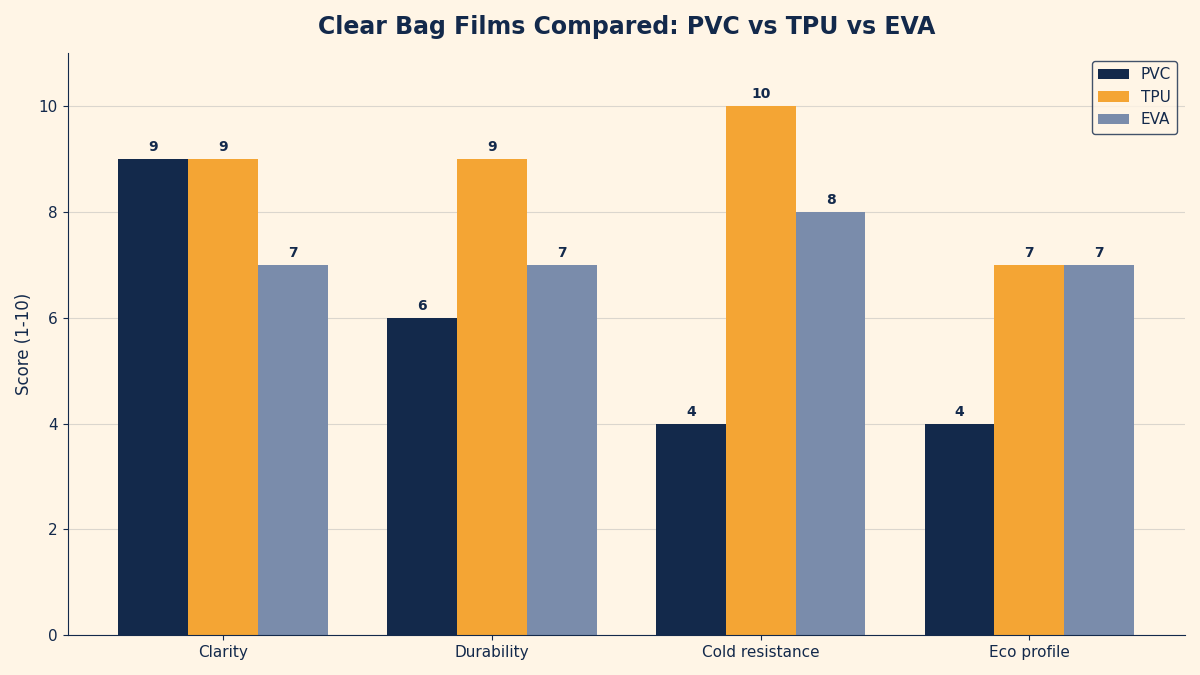
PVC (polyvinyl chloride) is the film most people picture when they think of a clear stadium bag. It is inexpensive, easy to weld and sew, takes screen printing well, and offers excellent optical clarity out of the box. For event giveaways, promotional totes, and one-season stadium bags, PVC clear bags remain the default choice for good reason: no other film delivers this much clarity per dollar.
The trade-offs show up over time. Standard PVC stiffens in cold weather and can crack below freezing, and cheaper formulations may yellow with prolonged UV exposure. If your bags will live in a warm climate or be used indoors, these limits rarely matter. If they will sit in a truck cab through a Minnesota winter, they will.
TPU Bags: The Premium Upgrade
TPU (thermoplastic polyurethane) is the film used in premium clear handbags and high-end stadium totes. It stays flexible in temperatures well below freezing, resists yellowing dramatically better than PVC, and has a soft, almost leather-like hand feel that reads as quality the moment someone picks it up. TPU is also free of the phthalate plasticizers that some organizations restrict, which matters for schools, hospitals, and government buyers.
The cost difference is real — TPU film typically runs 60 to 90 percent more than comparable-gauge PVC — but for employee bags expected to last multiple years, the per-year cost often ends up lower.
EVA: The Budget-Friendly Alternative
EVA (ethylene-vinyl acetate) sits between the two. It is naturally softer and more cold-tolerant than PVC, chlorine-free, and usually available in both glass-clear and frosted finishes. Frosted EVA is popular for retail packaging and cosmetics bags where a semi-opaque look is a feature. Its weaknesses are lower scratch resistance and slightly less crispness in print reproduction, which is why most logo-heavy stadium programs still choose PVC or TPU.
Vinyl Gauge Thickness: What the Numbers Mean
Film thickness is quoted in gauge or millimeters, and it changes the character of the bag as much as the material does. A quick reference:
- 15–20 gauge (0.15–0.20 mm): lightweight pouches and packaging inserts.
- 30 gauge (0.30 mm): the sweet spot for stadium totes — structured but foldable.
- 40 gauge (0.40 mm): heavy-duty employee and work bags that stand on their own.
- 60+ gauge (0.60 mm+): rigid fashion and display bags.
Thicker is not automatically better. A 60-gauge tote weighs more, ships at higher cost, and can feel stiff. Match gauge to workload: daily employee carry justifies 40 gauge; a game-day giveaway usually does not. Gauge also interacts with the material itself — a 30-gauge TPU bag will typically outlast a 40-gauge economy PVC bag because the film resists fatigue cracking at the fold lines, so do not treat thickness as a substitute for film quality.
Stadium Policies, Size Limits, and Printing
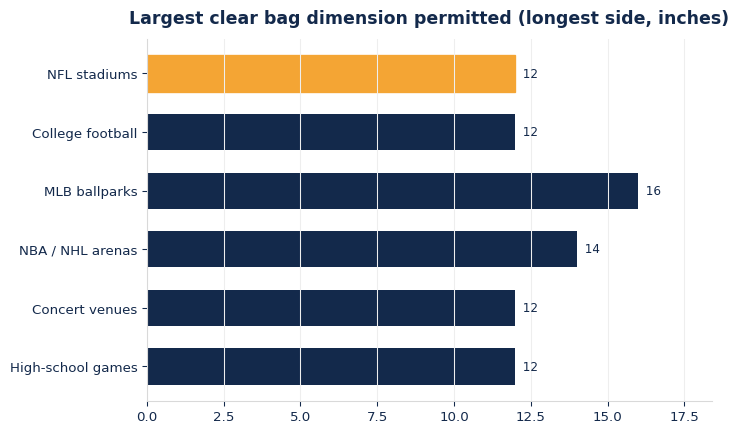
If your bags need to pass venue security, size comes before material. Most professional and college venues in North America standardized on the 12″ × 6″ × 12″ clear bag limit, with a small clutch allowance. Ordering a beautiful 14-inch tote for a fan giveaway means handing out bags that get turned away at the gate, so confirm the venue spec first and keep a half-inch of tolerance for seam allowance and gusset spread when the bag is full.
Printing behaves differently on each film as well. PVC accepts screen printing and heat-transfer graphics with crisp edges and strong opacity, which is why sports logos look so good on it. TPU prints beautifully too but usually requires a surface pre-treatment, adding a small setup cost. EVA’s softer surface can soften fine line work, so keep logos bold and simple on frosted EVA. For all three, a single-color print in the venue or company palette keeps unit costs down and sight lines through the bag clear — which is, after all, the point of a transparent bag.
Side-by-Side Comparison
| Property | PVC | TPU | EVA |
|---|---|---|---|
| Optical clarity | Excellent | Excellent | Good (frosted available) |
| Cold-crack resistance | Fair (stiffens below 32°F) | Excellent (flexible to −40°F) | Good |
| UV / yellowing resistance | Fair | Excellent | Good |
| Typical relative cost | $ | $$$ | $$ |
| Expected service life | 1–2 seasons | 3–5 years | 2–3 years |
| Best for | Giveaways, stadium events | Employee & premium bags | Retail packaging, cosmetics |
Clear Tote Durability: Where Bags Actually Fail
In our production experience, clear totes rarely fail in the middle of a panel. They fail at stress points: handle anchors, zipper tape junctions, and welded corner seams. That means construction quality matters as much as the film. Look for double-stitched or riveted handle attachments, welded-then-sewn seams on 40-gauge and heavier bags, and metal rather than molded-plastic zipper pulls on bags intended for daily use.
Care extends life regardless of film. Wipe bags with mild soap and water rather than solvent cleaners — alcohol and acetone haze PVC and EVA permanently. Store bags flat or stuffed with paper rather than folded; a hard fold left for months becomes a permanent crease and, in cold weather, a future crack line. With basic care, a quality TPU bag routinely reaches five years of daily service, and even economy PVC totes will deliver two full event seasons.
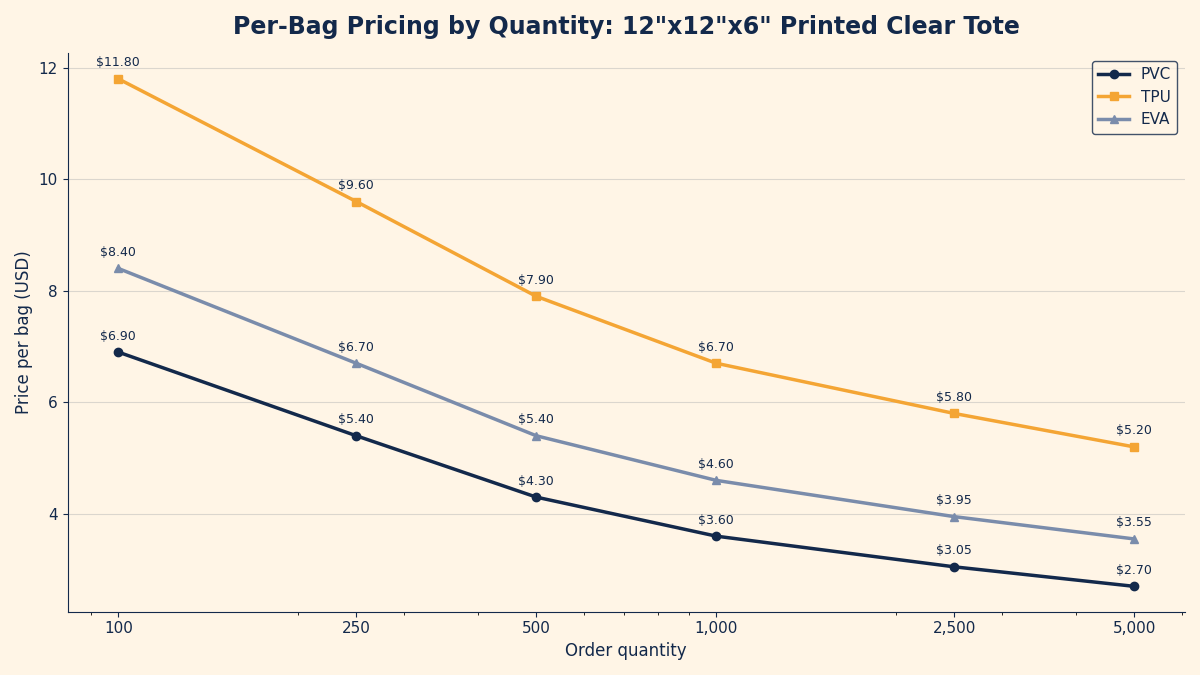
Cost by Quantity: How the Materials Price Out
Material choice interacts with order volume. PVC’s price advantage is largest at small quantities; at higher volumes, tooling and labor dominate and the gap narrows.
Which Clear Bag Material Should You Choose?
Use this shorthand: choose PVC when budget and clarity lead — event giveaways, fan totes, promotional programs. Choose TPU when the bag is a multi-year tool — daily employee carry, premium retail, cold climates. Choose EVA when you want a softer, chlorine-free film or a frosted finish for packaging.
If you are speccing bags for a workplace program, material is only half the equation — the rollout matters just as much. Our companion guide to employee clear bag policies for warehouses and retail covers policy language, sizing, and change management.
You can learn more about our production team, browse other guides on the blog, or explore custom options across our full clear bag lineup.
Ready to Spec the Right Clear Bag?
Tell us your use case, climate, and quantity, and we’ll recommend the right film, gauge, and construction — with samples before you commit.
Get a QuoteWin Free Stuff
Enter below for a chance to win plus receive 10% off your first order.
🎉 You are in!
Check your email for your 10% off code. Good luck!