Employee Clear Bag Policies for Warehouses & Retail: A Practical Rollout Guide
Employee Clear Bag Policies for Warehouses & Retail: A Practical Rollout Guide
A well-written clear bag policy for employees is one of the least expensive loss-prevention tools available to warehouses, distribution centers, and retail stores — and one of the easiest to get wrong. Done well, a clear bag policy for employees reduces shrink, speeds up bag checks at shift change, and protects honest workers from suspicion. Done poorly, it feels punitive, slows the exit line, and quietly damages morale. This guide walks through what the policy should say, which bags to issue, how to roll it out in phases, and the mistakes that sink these programs.
Why Employers Are Moving to Clear Bags
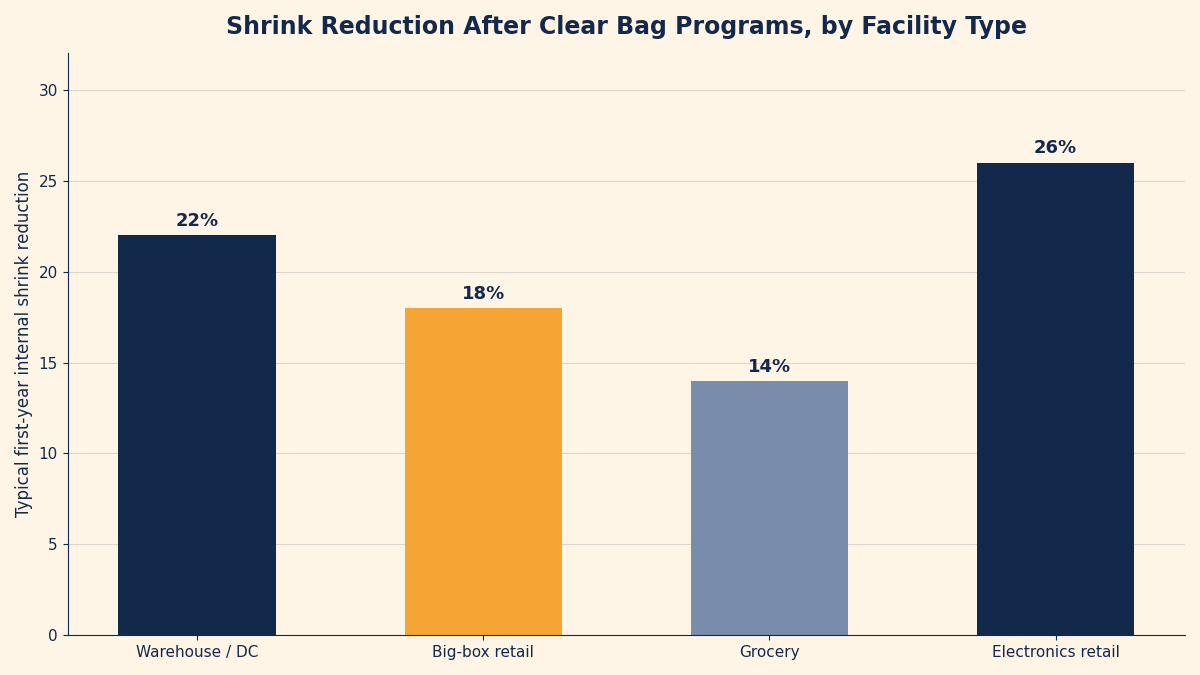
Internal shrink remains a stubborn share of inventory loss in both retail and warehousing. Traditional employee bag check policies — a guard opening every backpack at the exit — are slow, inconsistent, and confrontational. Transparent bags flip the model: instead of inspecting on demand, visibility is continuous and passive. Security staff glance rather than search, exit queues move faster, and the awkward “open your bag, please” interaction largely disappears.
What a Good Clear Bag Policy Covers
Keep the written policy to a single page. The strongest policies we see cover six points:
- Scope: who it applies to (all floor staff, contractors, temps) and where (production floor, stockroom, exits).
- Approved bags: the transparent bag the company issues, plus size limits for any personal clear bag.
- Exceptions: small opaque privacy pouches for medication and personal hygiene items — this single line prevents most pushback.
- Locker interaction: where non-approved bags are stored during shifts.
- Check procedure: what security actually does at the exit, so treatment is consistent.
- Consequences: a progressive, clearly stated response to violations.
Choosing the Right Warehouse Security Bags
The bag itself decides whether the policy survives contact with daily use. Warehouse security bags live a harder life than stadium totes: they ride on concrete floors, freeze in trailer yards, and carry lunches, chargers, and steel-toe insoles every day. Specify accordingly.
| Spec | Warehouse / DC | Retail floor | Why it matters |
|---|---|---|---|
| Film | TPU or cold-crack PVC, 40 gauge | PVC, 30–40 gauge | Trailer yards and freezer sections crack standard PVC |
| Size | 14″ × 12″ × 6″ | 12″ × 12″ × 6″ | Big enough for lunch + layers, small enough to check at a glance |
| Handles | Riveted web straps | Sewn straps | Handle anchors are the #1 failure point |
| Closure | Zipper with metal pull | Zipper or snap | Open-top bags spill on stairs and ladders |
| Extras | Interior privacy pouch, ID window | ID window | Privacy pouch defuses the most common objection |
For a deeper comparison of PVC, TPU, and EVA films — including cold-weather performance and gauge selection — see our guide to clear bag materials explained.
Rolling Out the Policy in Four Phases
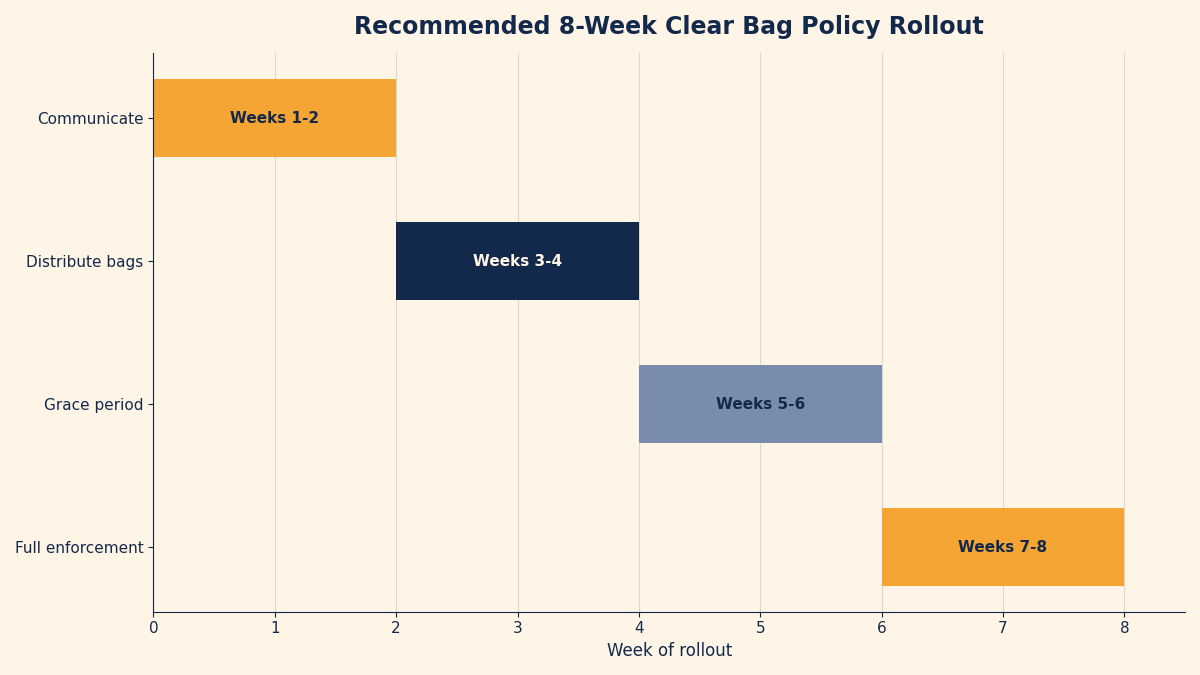
The rollout cadence matters more than the policy text. Programs that appear overnight generate grievances; programs introduced over six to eight weeks generate shrugs. A proven sequence:
Phase 1: Communicate (Weeks 1–2)
Announce the change, explain the why — protecting inventory protects jobs and bonuses — and publish the one-page policy. Invite questions and commit to the medication-pouch exception up front.
Phase 2: Distribute (Weeks 3–4)
Hand every employee their issued bag before enforcement begins. Nothing undermines a clear bag policy for employees faster than enforcing it against people who have not received a bag.
Phase 3: Grace Period (Weeks 5–6)
Reminders only, no write-ups. Supervisors model the behavior by carrying the bags themselves.
Phase 4: Full Enforcement (Weeks 7–8)
The policy goes live with consistent, documented exit procedures applied to everyone — including managers. Consistency is what makes the program feel fair.
Measuring Results: What to Track
The program pays for itself only if you can see the effect, so define the baseline before week one. Four numbers tell the story. First, internal shrink as a percentage of inventory value, read at your normal cycle-count or physical-inventory cadence — this is the headline metric, and most facilities see movement within one full cycle. Second, exit throughput: time a shift-change queue before and after rollout; clear bags typically cut per-person check time from twenty seconds to under five. Third, incident counts: documented policy violations and confrontations at the exit, which should fall month over month as the habit sets in. Fourth, a two-question pulse survey at day 60 — “Is the policy applied fairly?” and “Does the issued bag meet your needs?” — because a program employees consider fair is a program that survives its second year.
Report the results back to the floor. When staff hear that shrink fell and that the savings funded the holiday bonus pool or new break-room equipment, the bags stop being a security measure and start being a shared win.
Budgeting the Program
Cost planning is straightforward. A durable, logo-printed 40-gauge employee tote lands between $9 and $14 per unit at typical facility volumes, with TPU versions running a few dollars more. Plan for 110 percent of headcount to cover new hires and replacements, and budget a 20 percent refresh each year — bags do wear out, and replacing a cracked bag instantly matters for morale. For a 300-person distribution center, that is roughly $4,000 in year one and about $900 a year thereafter: less than the value of a single pallet of shrink in most operations.
Loss Prevention Beyond the Bag
Clear bags are a layer, not a cure. They work best alongside sensible complementary measures: consistent exit greetings rather than searches, camera coverage at pack-out stations, cycle counts that localize shrink to zones, and an anonymous reporting line. Facilities that treat the transparent bag as one visible piece of a respectful loss-prevention culture see the durable results; facilities that treat it as a gotcha tool see workarounds within a month.
Handling Common Objections
“It invades privacy.” The privacy pouch exception answers this directly, and courts have consistently upheld reasonable workplace bag rules applied evenly. “It singles us out.” Apply the policy to every badge level, including office staff who enter the floor. “My personal bag was expensive.” Lockers solve this — personal bags are stored, not banned. Address all three in the announcement rather than waiting for the complaints.
Getting Started
A clear bag program is one of the rare initiatives that is cheap, fast, and measurable: most facilities are fully rolled out within two months and can read the effect in their next inventory cycle. Start with the policy text, order bags built for your environment, and give the rollout the runway it needs.
Learn more about how we build bags for demanding workplaces, browse more operations guides on our blog, or see the full range of transparent totes on our homepage.
Outfit Your Team with Purpose-Built Clear Bags
We produce logo-printed employee clear bags with privacy pouches, ID windows, and cold-rated films — with volume pricing for full-facility rollouts.
Get a QuoteWin Free Stuff
Enter below for a chance to win plus receive 10% off your first order.
🎉 You are in!
Check your email for your 10% off code. Good luck!