Custom Clear Bag Buying Guide: Prices, MOQs & Specs
If you’re sourcing a custom clear bag for a stadium giveaway, a retail launch, or a trade show booth, the numbers that actually decide whether a vendor is a good fit rarely live on their homepage. Price per unit, minimum order quantity, PVC thickness, and how many days production really takes are the details that separate a smooth order from a scramble two weeks before an event. Pull them together first, then negotiate.
This guide walks through what a custom clear bag actually costs at different order sizes, how thick the material should be for your use case, what venues require if the bag needs to clear a stadium bag policy, and how long you should expect to wait between placing an order and having bags in hand.
Source: NFL.com clear bag policy; TarpsNow.com PVC vinyl specs; Yanxin Bag Co. and AdProsPB.com production/order data, accessed August 2026
How much does a custom clear bag cost?
Price per bag depends almost entirely on where you order from and how many you buy. Small-batch domestic printers charge more per unit but let you order in the low hundreds; overseas PVC factories charge far less per unit but expect you to buy in bulk and wait longer for freight.
On the domestic side, a supplier like Ad Pros of Palm Beach prices its 12″ x 12″ x 6″ clear stadium tote at roughly $0.75 per bag on top of a flat $60 setup fee per print color, with a minimum order of 100 bags. DiscountMugs lists its clear tote line starting around $1.62 per unit for smaller custom runs. Once you move to Alibaba-listed PVC factories with a 500-unit minimum, per-bag pricing drops to roughly $0.23–$0.31, though that price rarely includes freight, duties, or a hard color match to your brand guide.
The practical takeaway: if you need under 300 bags for an event next month, budget for the domestic per-unit price. If you’re stocking a retail line or running a recurring giveaway program, the math shifts in favor of a bulk factory order once you clear a few hundred units and can absorb the longer timeline.
| Order Route | MOQ | Starting Price per Bag | Notable Terms |
|---|---|---|---|
| Small-batch domestic printer (e.g., Ad Pros of Palm Beach) | 100 bags | $0.75 | Plus a $60 flat setup fee per print color |
| Promotional supplier (e.g., DiscountMugs) | Order-dependent | $1.62 | Small custom runs, faster domestic turnaround |
| Overseas PVC factory (Alibaba-listed manufacturers) | 500 bags | $0.23–$0.31 | Factory-direct; freight and duties add to landed cost |
PVC thickness and material quality
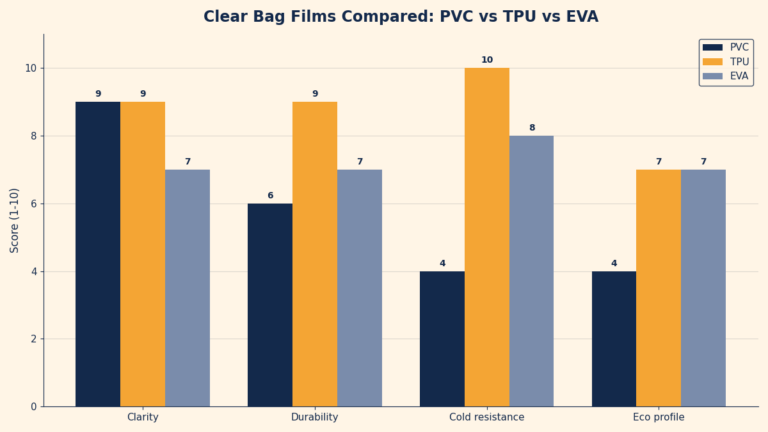
Almost every custom clear bag on the market is made from PVC, sometimes labeled vinyl, and occasionally swapped for TPU or EVA on premium runs. What actually changes the feel and durability of the bag is thickness, measured in mil (thousandths of an inch).
12 mil (0.012″) is the common baseline for lightweight totes, drawstring bags, and one-time giveaway items — thin enough to keep cost down, sturdy enough to survive a single event or short retail life. 16 mil (0.016″) is the step up for bags that need to hold real weight or survive repeat use, like stadium totes carried to every home game or gym bags that get tossed around daily. Heavier vinyl, in the 20–30 mil range, shows up in reusable totes and structured bags meant to last years rather than one season, though that thickness is more common in upholstery and tarp-grade vinyl than finished bags.
Ask your supplier for the mil spec in writing before you approve a sample. “Heavy duty” and “premium” are marketing terms; mil thickness is the number you can actually compare across quotes.
PVC vs. TPU vs. EVA
PVC is the default because it’s cheap to produce, holds a crisp print, and welds cleanly at the seams. TPU costs more but resists cracking in cold weather and yellowing under UV exposure, which matters for bags that will sit in a car trunk or outdoor booth for months. EVA shows up on softer, more flexible clear bags like cosmetic pouches, where rigidity matters less than pliability.
Minimum order quantities explained
MOQ is often the real deciding factor, not price. Domestic small-batch printers tend to set minimums around 100–150 bags because their setup costs are spread across a smaller run. Move to a factory-direct order and MOQs commonly sit at 500 units, with some manufacturers requiring 500–1,000 per unique design once you start mixing sizes or ink colors.
If your actual need is under 100 bags — a single event, a small pop-up, a sample run before a bigger order — look specifically for suppliers advertising low-MOQ custom runs rather than assuming every clear bag vendor can accommodate a small order. Some manufacturers explicitly market MOQs as low as 200–300 pieces specifically to undercut the more common 500–1,000 unit factory standard, so it’s worth comparing a few quotes rather than accepting the first minimum you’re quoted.
Getting the size right for stadiums and venues
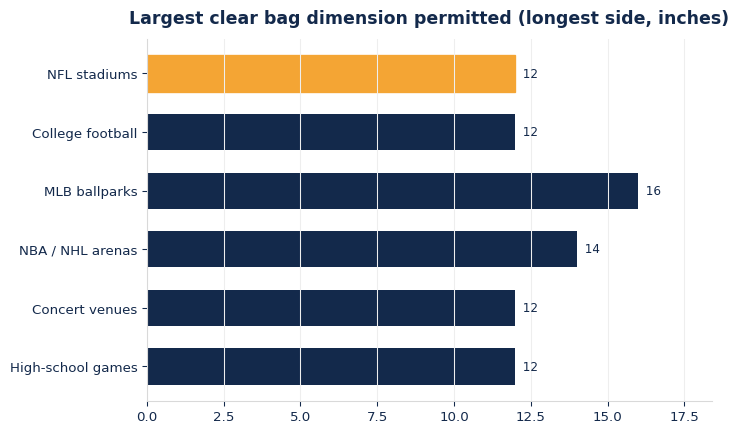
If the bag needs to get through a stadium gate, size is not negotiable. The NFL’s clear bag policy caps bags at 12″ x 6″ x 12″ (30.5 x 15.25 x 30.5 cm), and most NCAA football venues follow the same limit, though individual schools can set stricter rules. Bags also typically can’t have any hardware, buckles, or decorative elements that obscure the contents — anything opaque enough to hide what’s inside defeats the purpose of the policy.
If you’re ordering for a specific venue’s giveaway program, confirm their exact bag policy page before finalizing dimensions — some venues allow a slightly larger tote paired with a small non-clear accessory bag, and getting the combination wrong means a rejected order right before game day.
Lead times and production timelines
Turnaround time is where a lot of orders go wrong, because “production time” and “delivery time” are two different numbers. Once you approve final art, production on a custom clear bag order typically runs 10–20 days, though some manufacturers quote 3–4 weeks from confirmed design to finished goods, especially on larger or more complex runs. That’s before shipping — domestic freight from a US supplier can take days, while ocean freight from an overseas factory routinely adds another 3–5 weeks.
Sampling adds time on the front end. If a supplier already stocks the blank bag you want, expect an existing sample in 1–3 days. A fully custom sample — new size, new print, new hardware — usually takes 5–7 days to produce and ship before you even start the production clock. Build your order calendar backward from your event date: sample approval, then 10–20 days production, then shipping, with a buffer for at least one round of revisions.
Choosing between a domestic supplier and an overseas factory
Domestic suppliers cost more per bag but move faster, ship in smaller batches, and are easier to reach if a print run comes back wrong. That’s the right call for tight event timelines or first-time orders where you want to see a physical sample before committing to volume.
Overseas PVC factories make sense once volume is high enough to absorb a longer lead time and freight cost — think retail packaging runs, ongoing merchandise programs, or anything ordered many months ahead of when it ships. Before committing to a factory-direct order, get a physical pre-production sample, confirm the mil thickness and seam welding in writing, and price out freight and duties separately from the quoted per-unit cost, since landed cost is what actually determines whether the overseas price is a real savings.
Frequently asked questions
What’s the minimum order quantity for a custom clear bag?
It depends on the supplier type. Small-batch domestic printers often set MOQs around 100–150 bags. Overseas PVC factories typically require 500 units, with some asking for 500–1,000 per unique design. If you need fewer than 100, look specifically for suppliers advertising low-MOQ custom runs rather than assuming a standard factory minimum applies.
What PVC thickness should I order for a custom clear bag?
12 mil (0.012″) works for lightweight totes and one-time giveaways. 16 mil (0.016″) holds up better for stadium bags, gym totes, or anything that will be carried repeatedly. Ask your supplier for the mil spec in writing rather than relying on terms like “heavy duty.”
Will a custom clear bag meet NFL or NCAA stadium bag policies?
Only if it’s sized correctly. The NFL caps clear bags at 12″ x 6″ x 12″, and most NCAA venues follow the same limit, though individual schools can be stricter. The bag also can’t have hardware or decoration that obscures its contents. Confirm the exact policy for your venue before finalizing dimensions.
How long does it take to get a custom clear bag order made?
Plan on 10–20 days of production after you approve final art, sometimes 3–4 weeks for larger or more complex runs. That excludes shipping — domestic freight adds a few days, while ocean freight from an overseas factory can add another 3–5 weeks. A fully custom sample typically takes 5–7 days to produce before production even starts.
How much does printing a logo on a clear bag actually add to the price?
Beyond the per-bag cost, expect a flat setup fee per ink color — around $60 per color in small-batch domestic pricing — plus a per-unit imprint charge. Keeping your design to one or two colors is the simplest way to control that added cost.
The bottom line
The right custom clear bag order comes down to matching supplier type to your actual timeline and volume: a domestic small-batch printer if you need under a few hundred bags fast, a factory-direct overseas order if you’re buying in bulk and can plan months ahead. Nail down mil thickness, confirm venue size requirements if the bag needs to clear a gate, and build your production and shipping timeline backward from your event date before you sign off on a quote.