Custom Clear Bags for School & District Safety Policies
Custom Clear Bags for School & District Safety Policies
When a district rolls out a see-through bag requirement, families suddenly need to buy something specific, and schools need a version that looks organized rather than improvised. Well-made clear bags for schools solve both problems: they satisfy the visibility rule administrators are after while giving the campus a clean, branded look instead of a parking lot full of mismatched freezer bags. This guide explains where these policies apply, which bag styles fit each use, and how to order for a whole school or district.
Whether you are outfitting a single building or standardizing across a district, choosing the right clear bags for schools comes down to matching the bag style to how and where students actually carry it.
Why districts adopt clear-bag policies
Transparent bags let staff spot a prohibited item without opening or searching a student’s belongings, which speeds up entry and reduces the friction of hand searches. Administrators tend to favor them because they are consistent, easy to communicate to parents, and less invasive than random inspections. The policies show up most often at athletic events and large gatherings, but a growing number of campuses extend them to everyday backpacks.
Common triggers for a policy
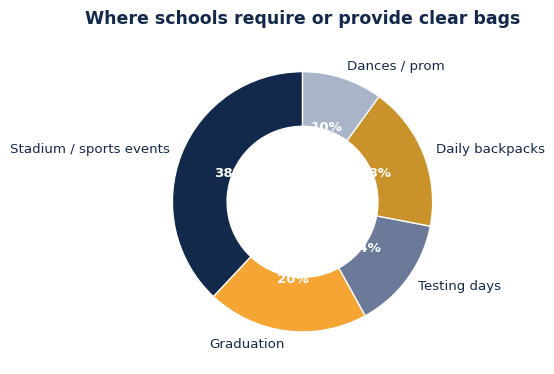
Football and stadium events are the classic starting point, mirroring the same 12x6x12 logic used at professional venues. Graduation ceremonies, standardized testing days, and school dances are frequent add-ons because they concentrate a lot of people in one space. When a district moves to daily clear backpacks, the goal shifts from event screening to a routine, everyday standard.
Balancing safety goals with student comfort
The most successful policies acknowledge that students carry personal items and build in the small exceptions that keep the rule humane. A permitted opaque pouch inside a clear bag lets older students keep private items out of view without defeating the purpose of the policy. Framing the rule around a shared standard rather than suspicion goes a long way toward buy-in from both students and parents, and it mirrors how professional venues handle the same tension at their gates.
Matching the bag style to the use
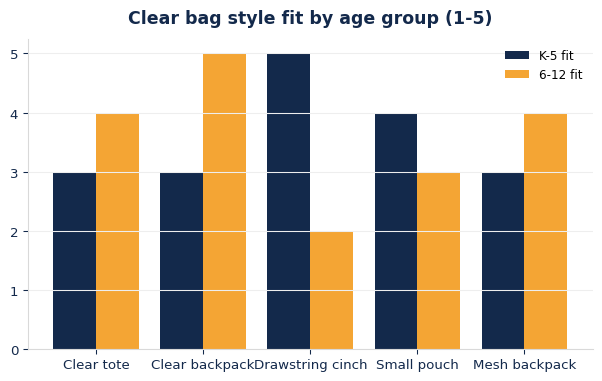
No single bag fits every situation. A stadium tote is ideal for game night but awkward for a full day of classes; a clear backpack works for daily carry but is overkill for a testing session. The chart below scores common styles for younger and older students so you can pick sensibly.
Ordering for a school or district
Buying in bulk changes the calculus. Reinforced seams and sturdy zippers matter far more when a bag is carried every day by a teenager than when it is used a few nights a season. A printed school name or mascot on a side panel keeps the interior visible while making lost bags easy to return and giving the program a unified look.
| Setting | Best style | Why |
|---|---|---|
| Stadium / event entry | Clear tote 12x6x12 | Meets standard event rules; easy to inspect |
| Daily backpack policy | Clear backpack | Holds books; built for everyday wear |
| Testing days | Small clear pouch | Fits calculators and IDs, nothing extra |
| Younger grades | Drawstring cinch bag | Light, simple, easy to manage |
Durability that survives a school year
An everyday clear backpack takes abuse a stadium tote never will: dropped in hallways, crammed into lockers, loaded with textbooks and a water bottle. Prioritize thick, welded seams, molded zipper pulls, and padded straps for daily-carry styles. Thin promotional-grade vinyl that is fine for one game night will split within weeks under real classroom use, and replacements erase any savings from a cheap first order.
Budget planning for families and boosters
Because bags are inexpensive per unit at school volumes, many programs fund them through the booster club or PTA and distribute them free or at cost. That removes the equity objection that stalls a lot of policies and guarantees everyone starts the year with the same compliant bag. If families buy their own, publishing an approved model and a price range prevents the confusion of dozens of slightly-different bags showing up on day one.
It also helps to standardize the printing across a district so every building looks part of the same system while still carrying its own mascot. A district-wide template with a swappable school name keeps art costs down and makes reorders trivial, since the vendor already holds your approved layout. Consistency at the district level is what turns a scattered set of building policies into a program that looks deliberate.
Communicating the change to families
The rollout matters as much as the bag. Publish the exact permitted dimensions, show a photo of an approved bag, and note the low-cost fallback so no family feels priced out. Offering a branded bag through the school store or booster program gives parents an easy, guaranteed-compliant option and turns a mandate into a small fundraising opportunity.
Sizing and buffer stock
Order a modest overage for replacements and new enrollments mid-year. Bags are inexpensive per unit at school quantities, and running out in October is a worse look than a small surplus in a supply closet. Keep a few in the front office for visitors and students who forget theirs.
A quick word on transparency standards
Just as at stadiums, “clear” should mean genuinely see-through. Lightly frosted or heavily tinted bags create judgment calls at the door and slow the very line the policy is meant to speed up. When you spec bags for a district, insist on fully transparent body panels and reserve any color for the trim, zippers, and printed mascot. That keeps enforcement objective and fast, and it prevents the awkward situation of a staff member having to decide whether a borderline bag counts.
Bottom line
Good clear bags for schools make a safety policy feel intentional rather than reactive. Match the style to the setting, order sturdy construction for anything carried daily, brand them for identity and returns, and communicate the rule clearly to families. Do that and the policy becomes a non-event, which is exactly what you want.
Standardize clear bags for your campus
Share your student count and mascot and we will spec compliant styles, branding, and buffer stock for the year.
Get a QuoteHome · About · Custom orders · Companion guide: stadium clear bag rules
Win Free Stuff
Enter below for a chance to win plus receive 10% off your first order.
🎉 You are in!
Check your email for your 10% off code. Good luck!